

Cast of Wonders 712: Little Wonders 54 – Change & Transformation
Between the Mountain and the Sea
by Matt Tighe
She liked being a tree on the island.
“It’s because you like having your roots in the ground,” her father said.
Her father was kind and loving and steady. Every morning, after he had walked the beaches and cast his wary gaze out on the Sea, he would go up through the forest to where the trees stopped and the land became rocky, and he would become the Mountain. He would sit there with his craggy face high above everything, and she knew he was feeling the solidness beneath him and inside him, and that he was content.
She did like being a tree and feeling how her roots went down into the ground. That was true. But she also liked how the wind would move her branches around, invisible and insistent.
Some days, when her father was being something else, like the water in the little spring that fed the animals, she would go to the very far end of the island. There, the Sea came right up to the forest under the crumbling cliff. Some of the trees had their roots in the broken rocks on the very edge of the drop, and they leant out like they wanted to drink. If she dared to be one of these, the water would foam and spit up at her, try to grab her and pull her down. It made her wood thrum and her branches shiver.
The Sea never talked, but she knew it hungered for everything that was on the island, and that it was wild and churning and not something she was ever allowed to be. It pulled at the island and swept the beaches clean, took away branches and leaves and even rocks, sometimes. It broke things down and then they became the Sea, too. It scared her very much, almost as much as disappointing her father.
But she would still go and be one of those leaning trees, sometimes.
One day, when the sky was bright blue and the sun had warmed her father’s craggy face enough to make him sleepy, she climbed to his shoulder and sat on a mossy rock.
“Father,” she said, as casually as she could. “Why does the Sea hate us so?”
“Hmmm?” he mumbled, without really turning his attention to her. “It does not hate. It is just the thing it is, my dear. It is too large and wild, and it cannot stop making everything it touches be part of itself.”
She thought on this for a while, partly because it needed thinking on, and partly because slowly was the best way to talk to her father when he was being the Mountain.
“But we are many other things, father. We are trees and rocks and lizards. You are often the Mountain. The Mountain is large.”
He laughed a little, the distant rumble of sliding rocks. “The Mountain is nothing to the Sea. But also, a Mountain is steady. A Sea is ever-changing.”
Then he shifted slightly, and she could feel his regard wakening.
“You cannot be the Sea, my dear. It will consume you.”
She thought of the wild foam and the way the water churned and sped, dashed itself against the rocks and pulled back, never-ending. Always changing.
“Would it, though?” she wondered, because how could the Sea consume her and keep her, if it was never the same? If it did not even know itself? But she had wondered out loud, and her father had come fully awake.
“No! I forbid it.” he said in his deepest voice of sliding and crashing stone, and several large boulders tumbled down and crashed into the forest.
She fled down his slopes, away from his wild and sudden anger and the pain she heard in his voice.
Later, her father came to her as she sat on the sand of the widest beach, far back from the waves.
He sighed. “The Sea is a danger, because it surrounds us, and it is wild and strange and will not stay still. We would not survive it, and it would not care if we did not.”
She said nothing. His words were solid, and she loved him for that. But also, there was the wind in her branches. And then foam roaring below her, sometimes. There were things he was not seeing, because he was too solid.
“Go and be a tree for a while, dear,” he tried, and his voice was soft and full of worry. “Remind yourself of how it feels. Maybe even be the Mountain. You will enjoy that. It is a very solid thing to be.”
Still she said nothing, because her anger was a new thing for her, and she did not want to hurt him with it. Eventually he stood and left, no doubt to be the Mountain again for a time.
She wished she wanted to be the Mountain, too.
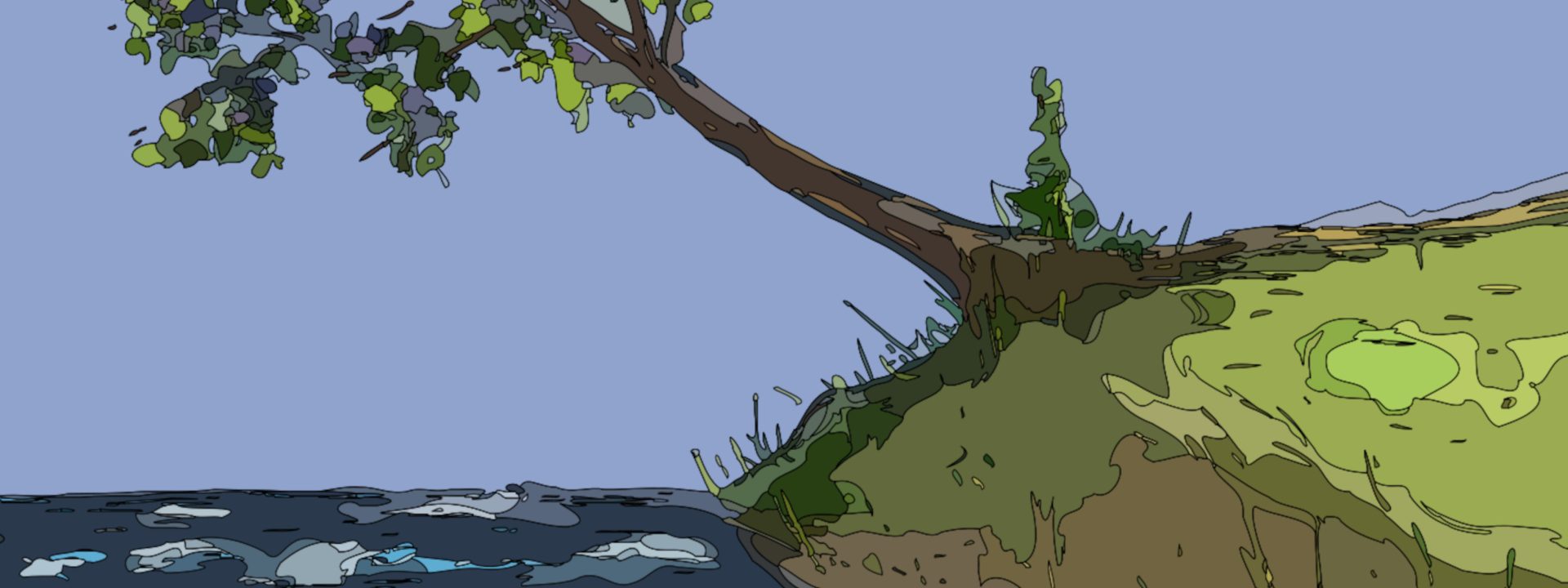
There was one tree she had never dared to be. It slanted almost horizontally from the edge of a terribly broken piece of rock on the cliff. The tree was always drenched in salt and spray. It held on with a few roots only, and the longest branches were white with dried foam and salt at low tide, and they swirled in the water at the highest. She had no idea how it was alive, how it stayed where it was on the tipping point of such change, nor why the Sea did not tear it from its mooring and destroy it utterly.
She strode down the island as herself, her hair flowing out behind her and her bare feet barely touching the sandy ground. In a flurry of anger and confusion, and with her fear churning inside her, she became the tree.
The water roared and foamed just out of reach, and she trembled in her leaves as each wave surged upward and towards her. The tide was coming in. The spray drenched her branches, and each droplet felt like a tiny piece of a fathomless forever.
She held herself in the form of the bent and buffeted tree. She both dreaded and hoped her father would see her foolishness, her bravery. She did not want to hurt him, did not want to harm his solidness.
She did not know what she wanted. Not completely.
“Would you tear me to pieces?” she whispered down at the water, even though she knew the Sea did not talk, or could not talk. “Make me be just you, and nothing else?”
And then, perhaps because she had brought the weight of her worries into the tree with her, or perhaps because things sometimes happen as they need to after years of nothing, the tree tilted. The roots gave, or the rocks crumbled, or both, and suddenly she was in the water, plunged into the salt and swirl and the rush of change that pulled at her very being.
She would have screamed as she sunk and spun, but it was all too dizzying and fast, and trees are not built to cry out. She sensed the rocks below her and behind her, the cliff now a wall to be dashed against.
The Sea picked her up and twirled her, sank itself into her, abraded her, plucked at her thoughts with its surge and power. She pulled herself tight, but the water washed through her, and suddenly she was not a tree, she was foam and current and gyrating nothingness. She spun and dove and weaved, and her thoughts scattered and became droplets within droplets, the glint of the sun and the coldness below. She tried with all of her will to be herself.
She was the tree, the Mountain, the island. She was her father.
She was the Sea.
She was nothing, and all of these things. Her roots went deep, and she swirled and changed, and she felt her father’s fear and the rush of the wind in her branches.
The Sea took her, and she was many things.
She lay on the beach, whole and shocked and streaming salt water from her skin and hair.
Her father found her there, with the water slewing around her legs.
“Oh, my foolish girl!” he cried. “The Sea will take you and destroy you!”
She sat up, and her panic melted at the sight of his anger.
“It did not though, father!” she shouted back at him, shouted for the first time ever. “I am here, and I am whole!”
She wanted to say more. That he had been right, that it had been horrible, and the Sea had stripped so much from her that she had stopped being herself, stopped being anything. But also, that for the first time ever she had not known what was happening. She wanted to say that her heart was still beating madly from the wild unknown of it all, and the terror had been delicious.
He shook his head.
“Luck!” he said. Almost sobbed the word out. “You were lucky!”
“No,” she said very slowly. Her anger was dying, because her thoughts were coming together enough that she remembered being torn to pieces. Dissolved and pulled into something larger.
She remembered her thoughts, at the end. How she had been nothing, and also many things.
“Father,” she said, finding the words only as they came to her mouth. “I was not lucky. I know the island. I know the roots of the Mountain and the trees and now I know how the Sea can take things away. I know these things, and I know who I am within that. We are the island, and we are Mountains, and the Sea cannot take that.”
He stared at her, solid, and steady, and a part of all she was.
“I need to know more, father,” she said. “I need to know the dangerous Sea beyond the island. I cannot just be the Mountain, and I cannot just be trees with deep roots.”
For a time he was silent. The Sea spent itself upon the beach near them, and it seemed like it was part of what had been said, and all that was yet to be said.
Finally, her father spoke again. His voice was not solid and rocky, but shaking and quiet. His eyes were wet, and they were full of regret, and hope, and farewell.
“It will be dangerous,” he said. “The Sea will not ever stop wanting to make you part of it.”
She smiled, and it hurt in a way she did not know smiling could hurt.
She kissed his craggy cheek and turned to the water. She stepped forward and became the Sea, but she remembered her father, and the island.
She remembered herself.
Father Tongue
by Ray Chanteur
Cal tells her dad about the wretched buck as soon as he gets to the clearing. Tells him how — after a mercy headshot stilled the panicked deer — the thing that had been its tongue began writhing out of the throat, undulating the soft white neck fur. How segment after segment of exoskeleton chased the curls of gun smoke out of the deer’s mouth, spilling out into the dirt.
The bug was surprisingly cute. Even backed against the tree, trembling, Cal felt an irrepressible urge to prod it with her rifle, the way she used to poke playground roly-polys with twigs. It reared up like a snake to stare at her — disapproval? recognition? — before skittering into the bushes.
Dad doesn’t believe her. But then, she’d had to come out to him twice because he forgot the first time. And when he sends a photo to the uncles’ groupchat (Cal’s first deer! So proud of Cal), she wonders if he’s avoiding pronouns on purpose.
On the way home, she searches Tongue Bug with the weak signal. The internet slowly loads photos of snacking frogs, colorful STDs — and Cymothoa Cervidae, a parasitic louse that eats tongues and then usurps them.
Cal summarizes the info to Dad: an all-male party of larvae foray into the unlucky animal, sneaking in on the deer’s snack and failing the Bechdel test until one bug decides he’d rather be a girl. When she’s done mating, the new matriarch crawls up the esophagus to the throat, drains the tongue of blood, and eventually replaces it.
Dad doesn’t take his eyes off the road.
“Probably the tongue thing was a birth defect. Or the deer landed on something when you shot it, and it crawled away once you came close.”
“I saw it come out the mouth! It’s exactly what’s in this photo!”
“Buddy, the internet’s got people believing all sorts of stuff these days. Some of those photos are just AI-generated…”
“I know what I saw!”
“Alright,” he says mildly.
“Why don’t you believe me?”
“Tell you what, why don’t I talk to the butcher about it? He’ll know.”
He’s not listening, he’s wielding affability like a brick wall, but she’s never successfully prosecuted that case and she’s too tired to try now.
“I’m not going to eat it,” she insists.
She turns to the window — he’ll never take her seriously if he sees her eyes welling up — and thinks how lucky the bug is. Partially because it can will itself into indisputable femininity, but mostly because it can bite someone else’s tongue.
The next week, she comes home from school to the smell of grilling venison burgers. Her throat tightens.
“You hungry? I’ve got a special patty with your name on it. I think I nailed the medium-rare we like —”
“What did the butcher say?
“Oh!” Dad’s face falls. “Buddy, it was such a long line — honestly, you saw it field dressed, it’s really just a normal deer…”
“That’s okay. My stomach hurts anyways.”
He sighs. “It’s cooked, it’s fine. C’mon and eat —”
“No, it really hurts, and I’ve got finals to study for,” she whines, and he throws up his hands in surrender.
In her room, she sketches the designs to be carved into her woodshop final project, a photo frame. Most of her classmates finished their simple mitered projects in class; Cal’s decided to make a badass masterpiece as a present for Dad’s birthday. Plus, she likes woodworking, likes getting lost in the rhythm of sanding, likes running her fingers over the smoothed wood.
It’s hand-work, and she’s always liked her hands, their calloused strength and dexterity. She’s been meaning to paint her nails to make them look as pretty as they are talented. She keeps asking Dad to take her to the drugstore so she can pick out nail polish. He keeps forgetting.
When the coughing starts, he refuses to go to the doctor, no matter how hard she begs, no matter that his voice sounds like 24-grit sandpaper.
“It’s just a sore throat,” he rasps, sipping a glass of water that’s not doing him any favors. “I don’t need to be a drama queen.”
It’s the last thing Cal hears him say.
All she can do is sit on the front steps, working the frame, heart racing every time his hacking erupts inside. She waits, and bites her lip, and carves things he likes into the willing wood.
She’s finishing the final details when he stumbles past her, in search of fresh air, in the throes of his worst coughing fit these past two weeks. She hides the frame behind her back, though he’s doubled over on the walkway, his attention elsewhere.
For a full minute, she can’t tell if the wet sound is coughing or retching. She’s about to offer to make tea when a thick pinkish-gray muscle thwacks onto the concrete.
Her father turns, clutching his throat, and in his gaping mouth Cal glimpses the bug crawl into the place where his tongue once was. It clicks twice. She rushes inside for her phone, but he sprints after her, stills her arm before she can dial 911, shakes his head.
Even with him silenced, she doesn’t win this argument.
He’s probably glad he’ll never have to admit I was right, she thinks, with a twinge of guilt.
It’s incredible how quickly Dad adapts to keeping his mouth closed at all times.
School’s out, so Cal has time to cook his favorite spaghetti-and-meatball recipe for his birthday dinner. She overcooks the venison meatballs, and still doesn’t put any on her plate. Dad turns his head to take bites, struggling with the new rhythm of eating, coughing up food with his hand over his mouth. She looks away politely. Occasionally, there’s a muffled clicking as he twists the noodles around his fork.
She reassures herself that the frame is waiting. That’ll cheer him up. She can barely wait until her plate is in the dishwasher to retrieve it from her room.
“I made it in shop.” She’s practically wiggling as he pulls off the tissue paper. “I got a hundred percent.”
With his tongue stilled, she has to imagine his praise: wow, the ivy on the sides is so detailed! Did you design the antler border yourself? This is amazing!
Inside the frame is her favorite photo of them, when Dad chaperoned the third-grade Boy Scout troupe’s overnight outing. Sunset shimmers on the lake sprawled out behind them, and Cal is snuggled up under his arm, still wearing the makeshift costume from earlier that night when the kids made up a play. She got to be the mom, hamming it up in her fake bedsheet-dress all night. They both look happy. Like there’s nothing unspoken between them.
Dad runs his hands along the ivy-and-antler border, nodding. He claps her on the shoulder with as wide a smile as his closed mouth will allow. Cal flushes with pride.
Then he hangs the frame behind the basement door.
For a few days, the weight in her chest pins her to the bed. She holes up in her room, sanding down scraps just for the motion of it. Dad knocks on the door for meals, and she pretends she’s asleep, then raids the pantry for pretzels after he goes to bed.
Without the soft earplugs of his words, his actions ring out like a gunshot.
On the third day, she puts on her favorite tee and walks the mile to the drugstore. It’s sunny, and crisp, and the sugar maples lining the street blush warm colors. She beelines for the wall of nail polish, standing back to admire the rainbow expanse of options. Dad’s tongue is a girl, and Cal’s heart has grown an exoskeleton, and Cal is determined to carve out her own future.
At home, she paints her nails hunter-orange. The aerosols sting her nose, and her right-hand cuticles get doused in her inexperience. But the motion is as soothing as sanding, and for once she’s adding layers to something instead of scrubbing them away.
Dinner that night is quiet except for bug-clicks and silverware, and when Cal reaches to clear Dad’s empty plate, his eyes linger on her fingertips. She takes her time clearing the table, stretching out her fingers, showing off her bright and lovely handiwork.
Her father says nothing at all.
About the Authors
Ray Chanteur

Ray Chanteur (she/her) is a professional teen whisperer and a writer of short speculative fiction. Her work has appeared or is forthcoming in Small Wonders, Fission, Anomaly, and Bona Books’ Wrath Month. She is an alumna of Mary Robinette Kowal’s Short Story Cohort. When she isn’t writing, she knits socks, runs slowly, and cooks too much soup. You can find her on ray-is-writing.bsky.social.
Matt Tighe

Matt lives on a small farm in south eastern Australia with his amazingly patient spouse and kids, the dogs Sherlock and Enola, and Mycroft the cat. He is a Professor of environmental science, researching pollution and sustainability, and has won a few writing awards. You can find a list of his stories at matttighe.weebly.com as well as a cool picture of his brain drawn by his oldest son. His wife would like him to write some stories with happy endings, and he has said he will think about it. His bluesky handle is @mktighewrites.bsky.social
About the Narrators
Jess Lewis
Jess is a trans non-binary and pansexual writer, designer, and artist who hails from the hollers of Western North Carolina. They currently live in the deep South, where they explore futures of liberation and how to get there. When they’re not imagining weird queer cli-fi utopias, narrating stories, or facilitating capacity-building workshops, they’re organizing programming with their local queer community and The Outer Dark Symposium on the Greater Weird. Their work has appeared in a range of publications, including Solarpunk Magazine, HyphenPunk, and Kaleidotrope. You can visit their website at https://www.quarefutures.com and follow them on Instagram @merrynoontide
Rae Lundberg

Rae Lundberg is a writer and voice actor from Kentucky. In addition to co-writing and acting for The Night Post, Rae is also the showrunner and sound designer. Their writing and sound design work can be heard in Nine to Midnight and KILL FM, and they have lent their voice to dozens of audio drama podcasts. A former English teacher, copy editor, and freelance journalist, Rae holds an MFA in Creative Writing and works in patent licensing for a university. They live in the SF Bay Area with their wife, three cats, and overflowing shelves of queer books. You can find more of their work at HeyRaeVA.carrd.co.
