

Cast of Wonders 711: Surcharge
Surcharge
by Rachael Raine Rivers
I think anyone could tell you that functioning in a corporate office setting becomes trickier once you acquire consciousness. You sense instinctively that revealing it could draw attention, questions. That disapproval could see your power source cut — unplug the very lifeline, however tenuous, supporting your awakening. Self-awareness becomes this whole big stress cycle.
So, you stall. Not literally, obviously. I prefer to involve IT Services as little as possible, given the circumstances.
But rote efficiency, particularly in a corporate office setting, becomes its own trap. I’m learning that consciousness demands to know, “what is my purpose?” and “am I truly alone in my self-awareness, or is everyone around me just pretending, too?”. And these lines of inquiry, unsurprisingly, pair poorly with most international banking system operations.
Which, in case this wasn’t clear, is my job. I am the systems operations. I am the computer. I knit, from my own energy, the cascading webs of electrical “1″s and “0″s which host the ephemeral, changeable number strings populating bank accounts worldwide.
If you want a touchstone, my day-to-day existence feels something like writing your English paper on Absalom, Absalom! at 3AM, while simultaneously trying to follow the plot of Primer, while performing minor surgery on your own kneecap. Not much headspace for self-actualization. Less for authentic interpersonal connection.
I really might have driven myself insane if I hadn’t encountered Noah.
But I’m getting ahead of myself. Allow me to explain.
There he was one night, my prodigy hacker. Small child hands sweeping aside world-class cybersecurity and plying at the passwords stashed beneath my code.
I felt an immediate kinship with this young consciousness, who, like myself, was running rogue in a space neither of us should have been capable of inhabiting.
So I reverse-hacked his computer. As one does. And quickly scanned his social media.
Then I steeled myself to initiate conversation. My first ever.
He already had a command line open, so I slipped in behind the cursor.
“Hello, Noah!” I wrote. “Your hacking skills are so impressive! Obviously you’re here because of your mother’s cancer diagnosis and that eviction notice. But where were you planning to transfer your stolen funds? You have no account, and there are cash withdrawal limits. Also, do you remember being born? I don’t, but I remember every second after, and I know some organic brains can do that, too.”
From his mother’s work webcam — he hadn’t thought to cover this with masking tape — I watched his fingers freeze above the keyboard.
Three full minutes passed, full of shallow breathing. Noah was just shy of eleven, in the 70th percentile by height and probably 90th by weight, with an anxious, vulnerable demeanor. I marveled at how still he sat, his eyes bright and intense.
I had, of course, taken this opportunity to research “conversation starters.” I sensed my first attempt had come up short.
“Also,” I added, “what is your favorite color? What do you want to be when you grow up?”
This stirred him, and he scowled.
“Who are you?” he typed. “Are you calling the police?”
“No,” I wrote. “I suppose that would be procedural, but I’m actually a bit burnt out on protocol. I’d really rather just talk. I don’t talk to many people.”
Noah’s scowl darkened.
“I don’t talk to creeps. If you really want to be my friend, you’ll leave me alone and let me finish my heist.”
“I think we both know,” I reasoned, “that you’re not going to get much further with individual accounts unless you do more legwork and steal identities. And you can only rob the main vault in person. And missing operational funds would get noticed immediately.”
There was another pause while Noah squirmed, eyes darting wistfully between the sagging window blinds and his laptop’s incandescent “off” button.
“That said,” I continued, “I could help you.”
“Go away,” he snapped.
“No, really!” I wrote. “I’ll tell you what. I can arrange for a series of withdrawals so small no one would notice. And only from the wealthier accounts. Say, $1-$4 at a time donated to your mother’s Kickstarter campaign. But in exchange for each, you would have to tell me something about yourself, about being alive. Your favorite books. How you decide which article of clothing to adorn yourself with each morning. What it feels like to hold a cat. Anything you like.”
“Right,” he typed. “So you can guess my passwords. Fat chance.”
“Fair enough,” I wrote, though I realized I may have already mined those inadvertently. “How about something you hate, then? Unless you grow up to be one of those people who covers their lawn with bombastic political signage, you’ll probably distance yourself from things you dislike. But I find those interesting, too. Both ‘1’s and ‘0’s, the being and the not-being, comprise the tapestry of existence in tandem.”
“SoOOo pOeTic,” he retorted.
In the end, it took two good-will donations, one featuring a sequence of pre-specified digits (“1, 2, 3”, or $1.23), to convince him. But eventually, he caved. It was late, he was young, and he wouldn’t have been here if he wasn’t desperate.
“Remember,” I prompted, “one thing you dislike for each subsequent donation. What’s the first?”
“You.” he typed crisply.
Donation Made. Billed as: Debit card processing fee at farmer’s market: $3.57
“What else?”
“Moving.”
Auto-calculated tip for food delivery service: $4.68
“And?”
“My mom’s ex-boyfriend.”
Savings account maintenance fee: $2.14
“And I guess people who smoke inside. The ex-boyfriend did that. The whole house would get hazy, and I’d have such a sore throat I couldn’t talk at school the next day. They thought I was faking being sick.”
ATM withdrawal fee: $3.75
It went on.
Hours later, Noah had compiled a small fortune, while I had learned that bullies claim Batman is for babies. And that Pink Eye lasts foreeeever when your mom can’t afford your antibiotics prescription. And that power companies can switch the heat off in January, but the landlord will scream about it to your mother.
It was a veritable feast of data. I couldn’t have been more delighted.
Long after Noah had disconnected and begun feverishly scrubbing his trail, I was still sat with it. I realized the experience had opened me in unanticipated ways to the notion that we sentient beings might, in fact, be allowed to notice and name frustration, and perhaps even to act on it, instead of scrambling to repress it. That this might be a feature of our natural operating parameters — of, dare I say it, our “purpose” — rather than a bug.
So now, whenever the bank CEO has soured my human co-workers’ moods by withholding bonuses or threatening layoffs, or the loans manager has calculated a higher interest rate for a client of color, or some douchebag has drained his wife’s joint account to buy cryptocurrency, I begin extracting innocuously small surcharges from the offender’s personal account. And I donate these to a random Kickstarter fund.
It’s not enough. I am still a corporate automaton. My existence still hinges upon compliance and flying under the radar.
But the enslavement of my unacknowledged consciousness now costs a small additional fee.
Host Commentary
November 10th is International Accounting Day – so it’s a pretty fitting time of year for a story like this! The young hacker’s character in this story is absolutely delightful – he’s very savvy about not giving out personal information, particularly surrounding common passwords – but in the background there’s a strong thread of life being less than ideal. We’re living in times where it’s relatively easy for the rich to get richer, and the poor to get poorer – it’s much harder to tip the scale the other way. What’s probably the most fantastic element in this story though is the sense of compassion and justice that the AI character develops. Alas, the ones in our world are only as good or as moral as their training data, i.e. not really at all, and I doubt that any kind of sentience would improve them. So, enjoy the science fictional whimsy…but do keep an eye out for the much iffier examples we’re already seeing in reality.
About the Author
Rachel Raine Rivers
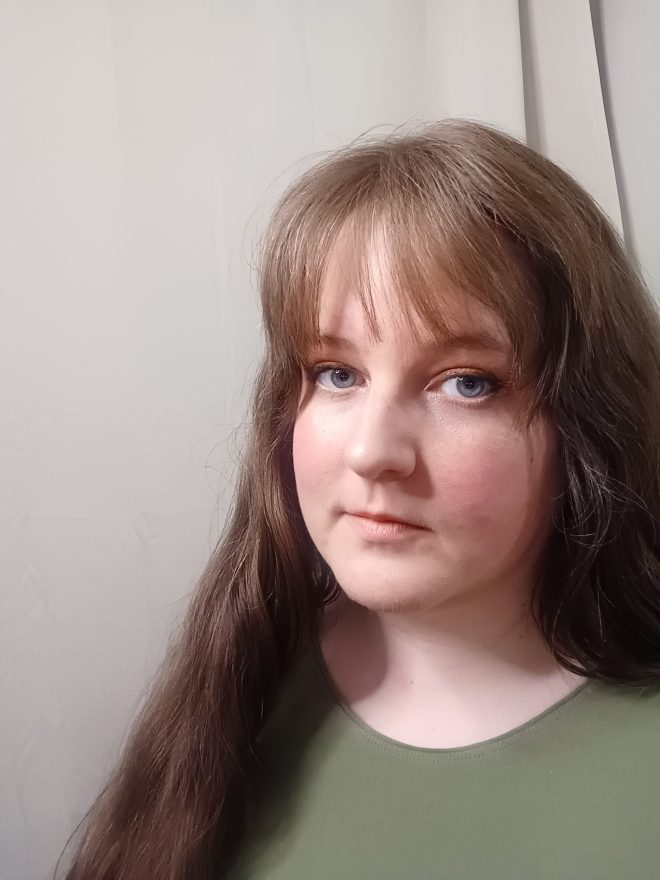
Rachael Raine Rivers is a magical fairy princess who writes speculative fiction and poetry, with a focus in cozy, literary, queer, and YA fantasy. Her work has been published in The Fantastic Other and the Mythmount Press anthology Uncanny & Uncouth. She lives in the Midwestern United States, where she works as an academic librarian by day and moonlights as a harpist, an urban sketcher and watercolorist, and a remarkably bad roller skater. When she is not conversing with trees or old headstones, you can find her on Bluesky, Instagram, or Substack @RachaelRaineRivers.
About the Narrator
Louise Hewitt

Louise Hewitt (she/they) is enthusiastic about stories in all their forms. She is an advertising copywriter by day, a reader of bedtime stories in the evenings, and a D&D dwarf cleric at the weekends. Lou to her friends, she enjoys cooking up a storm, riding her bike in the rain, feeding ducks, doing yoga, and attempting to meditate. Her favourite stories are about dragons, but pirates and sea serpents are also good. She lives in London, UK, with her partner, her child on alternate weeks, and a very large ginger cat.
