

Cast of Wonders 708: Standing in the Shoulders of Giants
Standing In the Shoulders of Giants
by Adrian Ward
“Lotta rain clouds today,” Teru says. I look up to find him standing on the balcony, spyglass pressed to his face.
I walk over, lean on the railing next to him, follow his gaze down to the clouds. It doesn’t take a spyglass to see the tides of dark gray, swirling where Iapetus’ legs disturb them. Vedimar hawks, made tiny by distance, circle somewhere around the titan’s stomach, picking at anyone foolish enough to poke their head out. As I watch, a hawk’s body drops, then slowly rolls towards Iapetus, snagged on a reelbow line that’s too thin to see from up here. Its fellows circle angrily, then scatter as a redtail drake pierces through the cloud bank and takes aim at them.
I point it out to Teru, and he begins rattling off facts about the drake, excited to the point of stumbling over his words. He wanted to be a biologist at one point, but failed the university entrance exams. I wanted to be a copter tech, but Iapetus makes everything small, even dreams. I think that’s a half-clever line, and I start to tell it to Teru, but he’s not paying me any mind. He whoops, grabs me by the arm and shakes it, points eagerly as the redtail drake dives. It comes up clutching a hawk, tears its wings to shreds before plummeting back through the clouds, meal in tow.
“Think Iapetus will lie down under the rain tonight?” Teru asks me, when he’s finally done yelling. Someone next door yells back at him, and he at least has the grace to look embarrassed as we retreat back into our room.
“Hope not,” I say, reaching back to try and loosen up my shoulder. It remains irritatingly stiff. “Tunnels will flood.”
“So? Means we get a day off from laying myco, at least ‘til they get them pumped.”
“Yeah, but all the vermin’ll come running out, and then we’ll have to deal with ‘em.”
“They can bring it on,” he says, beating a fist against his chest. “I can handle some lil’ ratties.”
“They found a bear around node 36c last week. Just about mauled a rookie.”
“Where’s that one again?”
“Towards the end of the root.” I grab a rootmap from the kitchen table, toss it to Teru. He skims it before dropping it back onto the table.
“Weren’t the bears supposed to be dead by now?”
“Evidently not.”
“Great,” he mutters, grabbing his jacket off the back of a chair and slinging it over his shoulders. “Where’re the flashlights at again?”
I hold them up, allow him to take one.
“You’ll make a good spouse one day,” he says, clapping me on the shoulder. “That black-haired woman at the café still coming on to you?”
“Chloe?”
“Chloe,” he mocks, straining the C. “You two are that close already, huh?”
“I don’t go to the café anymore. And just knowing names isn’t that close.” I lock our door as Teru starts off down the hall, giving the handle a sharp tug to ensure the bolt engages. It’s been on the fritz for a while, but repairs are low on the Council’s priorities.
“Plenty of fish in the sea, even if one doesn’t work out. You see the woman from Atlas who visited the last time we got close?”
“The ambassador?”
“Yeah, her. Prettiest damn eyes I’ve ever seen. Whole group had good eyes, really.”
I hit the button to call the elevator. “They grow their kids in vats over there. Eyes included.”
“They’re still pretty. Prettier than anyone ‘round here, at least.”
“Maybe that’s the point.”
He cedes that with a grunt.
“How’d you get to see them up close, anyway? I didn’t think they left the high district.”
The elevator doors ding open and we step on. Teru punches the button for the top floor, grins at me. “They didn’t. One of the staffers at the welcome party owed me a favor, and they had spare uniforms. Got paid, too.”
I shake my head, laughing at the thought of Teru in a tie, pouring wine for some sharply dressed asshole. “Sounds fun.”
“Good food, good wine, and I even got one of the upper-crusters to wink back.”
“You’ll wind up in the lockup one of these days.”
“But not yesterday, and not today, either.”
“The day’s still young.”
“But I’m younger, and I’ve got the knees to outrun it.”
“The night’ll catch up to you.”
He thinks about that one for a second. “Shut up.”
The elevator doors open onto the surface of Iapetus’ left shoulder. The smell of growing things floods in, that heady mixture of dirt and decomposition that marks a garden. The entire space is covered in them, nestled in furrows dug into the titan’s flesh to shelter the plants from the wind.
I follow Teru through an apple orchard, past a grove of orange trees that must be engineered to withstand the cold, and to a small tunnel. The sign out front of it reads “Node 14a”, and I’m left pleasantly surprised that Teru remembered where we’re stationed today.
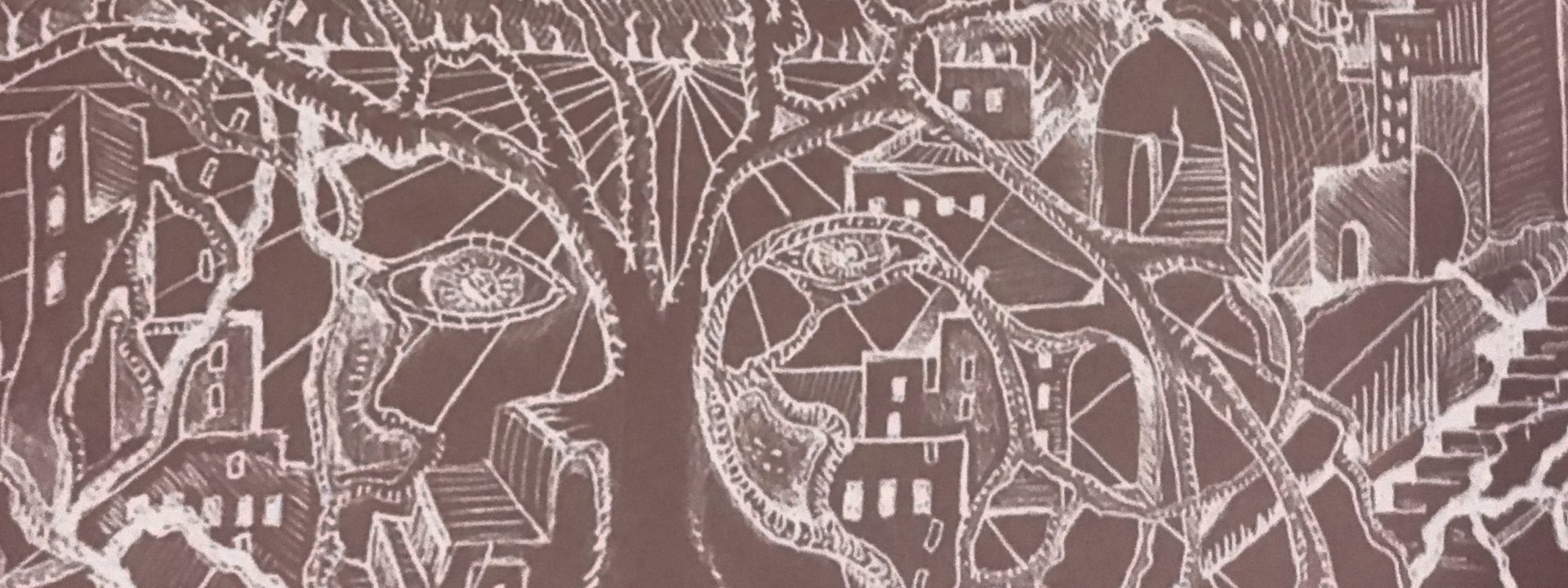
The Greattree looms overhead, a crown a mile high topping Iapetus’ enormous skull, roots dripping down the sides of the titan’s head to burrow into the softer meat of its shoulders and back. Leaves the size of a man toss shadows across the gardens, forcing the plants to lean in search of sunlight. Far above, leaves are spiraling down, and the flashes of Leafcatcher lasers blink across them, turning them to ash before they can land. I take a moment to admire one particularly oversized leaf as it goes up in flames, crumbling away to nothing.
A foreman stands in front of the tunnel, clipboard in hand, frown illuminated by the flashes of leaves burning, hair dusted with ash. He’s annoyed, and I flash him my most disarming smile, but that only makes his frown more sour.
“Teru Nivimas and Shelt Palamo?”
“Yes to both,” Teru responds, tapping his ID against the little badge as the foreman proffers it. It beeps as it turns green, and I follow suit.
“We’ve got mites along the root, here. Clear them out as best you can. Fumigation squad will be along eventually. You’ve got your gutters?”
Teru pops the blade out to show, while I simply move the end of my jacket to the side, revealing the sheath where it sits against my hip. The foreman nods, notes something on his clipboard.
“There’s ten percent bonus pay if you manage to clear them out today. Five if it takes two. Any questions?”
I shake my head.
“Good luck, then,” he says, flashing his teeth in what could charitably be called a smile.
The passage winds down into Iapetus’ body, its entrance a gaping pockmark on the surface of the flesh. The air is thick, the heavy reek of meat only slightly dampened by the fresh, clean smell of the Greattree’s roots. We descend a series of crudely carved steps, flesh-floor spongy underfoot. I flick on my flashlight as the light from the entrance filters away into nothing.
Another few flights of steps and the target root appears, jutting out from the walls as the passage winds down farther. It’s a small one, only a dozen feet or so around, and the passage that accompanies it doesn’t even require support beams. The occasional mite lies on the floor beneath the root, evil-looking red bulbs neatly slit down the middle and left to be cleaned up later. I wrinkle my nose at them.
“Why are we here?” Teru asks. Anyone who didn’t know him would think the question abrupt, but he asks it at the start of every shift we take.
I’ve never been able to give him a satisfying answer.
“To clear out the mites, Teru, to put food on the table and get housing, since neither of us was able to get through university.”
“I know that,” he says. “Still.” He waves a hand, as if encompassing everything around us, sweeping up Iapetus and the Greattree and the Council in one neat gesture.
After years of the same tired conversation, my response is automatic.
“We’re here because some asshole decided to engineer the titans, then realized that maybe living on the ground with them wandering about was a stupid idea. And then some other asshole decided to kill them but couldn’t figure out how to do it without laying waste to everything around. So, they put the big-ass trees on them to suck the life outta them, cause smart people can’t be bothered to come up with simple solutions, and we have to tend the damn roots.”
He sighs. “Just let me complain.”
“I thought you were asking a question?”
Teru’s stopped listening, though, so I have to be satisfied with my own wit. Or half-wit. Something like that.
“Can’t wait for it to die off,” he mutters, tracing a hand along the wall.
I can, but it’s easier not to argue. “We won’t be here to see it,” I say instead.
“Probably not.”
The passage opens onto a sort of cavern, where the root twists around itself in knots the size of six people lying end-on-end. The root is covered in little fist-sized mites, their purplish mouthparts sucking, sucking, sucking. A pair of roottenders are working to peel them off of the myco that helps the roots take Iapetus’ lifeblood even more voraciously, but the mites are still everywhere.
“Can we just chop ‘em?”
The other tenders don’t bother to look up at Teru’s question, but one of them nods, taking off another mite with a flick of her gutter. It detaches from the root, still squirming until the tender puts a clean slit down its stomach and drops it into a sack that’s already filled with leaking corpses.
“Fine enough, then,” Teru says, flicking his gutter up into his hand.
“Watch out for bears,” I joke. He brandishes the palm-length blade as if it would do anything against a bear, baring his teeth and glaring.
“Maybe they should watch out for me.” The effect is only slightly diminished by a mite dropping down onto his shoulder, squirming for a moment before he backhands it into a wall. It lands with a sticky smack, falls to the floor a ruined mess. Teru grins.
“One down. Few thousand to go.”
We spend the day chopping mites from the root. A hip-high robot trundles by every once in a while, a single light flashing from its back. It brings fresh sacks, exchanging them for the sacks full of mites that will be processed into dyes, or food, or whatever they’re good for. Teru knows, but he won’t tell me, only says I’m better off not knowing.
The thin currentgloves that the Council issues keep the mites from making direct contact with my flesh, but I can still feel their insides splashing against me. Sometimes, the splash makes its way up to my unprotected arms, making me shudder. Teru tells me I should’ve worn a coat.
It’s mindless work, but tiring. We take a short break for lunch, but then it’s another five hours hacking at the little pests. There’s a spot or two where they’ve dug into the root to lay their eggs, little clusters of black surrounded by weeping sap. They’re satisfying to burn out.
I’m relieved when we finally leave for the day, bonus be damned. Teru follows me back to our apartment to grab our sap bucket, both of us taking a turn in the shower and tossing uniforms into the laundry. Hot jets blast over me, steaming my skin, and it’s almost enough to wash away the feeling of warm guts splattering against my arms. The feeling lingers as I pull on a fresh set of clothes, relishing the feel of the fabric. I lock the door as we leave, Teru, as always, not remembering.
“Which tap are we using today?” Teru asks.
“The one over by Setin’s.”
“Damn. Long walk.”
It’s a half mile to the tap, winding through passages carved into Iapetus. Between two of the titan’s ribs is a sort of square, surrounded by the shops that have been hacked out of the walls. There’s a handful of residential areas around here as well, for people who prefer the relative safety of the titan’s innards to the views that those of us on the edge get. Teru and I don’t get much choice of where to live, under the Council’s employ and using their housing, but for what it’s worth I prefer the view.
The line stretches around the square today, buckets in hand, waiting to be waved through to the tap that forms the square’s central plaza.
“It’s not even a taproot,” Teru mutters, a joke that was funny the first time. Five years ago. I don’t bother responding.
The line limps forwards. We finally reach the tap, a long chunk of pipe that descends from the massive root overhead, and I hand our IDs over while Teru tosses our bucket under the tap. The scan blinks green, whines as it verifies our allotment, and far above mechanical bits whir, pulling down gallons of sap. Teru sticks his finger into the bucket as he picks it up, has a taste.
“How is it?” I ask as we walk off. He shrugs.
“Sweeter than usual.”
The walk back to the apartment takes longer than it should, in part because the work of chopping mites has left both of our shoulders too sore to easily lug the bucket. We trade it off, each carrying it until we can’t anymore.
In much larger part, it’s because Teru keeps stopping to chat with anyone he recognizes. It’s the fifth or sixth person, an old woman who runs one of the liquor stores, who tells him that Iapetus is headed for a city.
That gets him to rush back home.
The city must stand taller than anything made by Man should, because as we approach, it becomes clear that the tops of the towers come up to Iapetus’ knees. Buildings have been knocked out where some Titan’s been through before, leaving a smile of a skyline with half its teeth missing. Iapetus adds its own craters with every step, and I watch buildings topple as easily as a child’s toy blocks. Gleaming spires and crumbling homes turn to dust in our wake.
Just as Teru goes to step out onto the balcony, it retracts, blast shields slamming down. View blocked, he slumps onto our couch, sighing.
“I suppose that the Council thinks their defense systems still have ammunition,” I tell Teru, pointlessly.
“You think?” A loud boom punctuates his sarcastic return, then another, and another as missiles explode up and down Iapetus. The sap bucket shakes as I nestle it into the fridge. The titan continues on, as unperturbed as if it were being pelted by grains of sand.
“We’re gonna have extra work tomorrow,” Teru groans, throwing one arm over his face and gripping a pillow to his back with the other. A moment later, my comm buzzes.
“See?”
I ignore him as I skim the message. “Off the mites, at least.”
“Council get a few fumigators’ asses onto them?”
“Maybe. Sounds more like they’re just worried about the myco coming loose after the bombardment.”
He groans.
“What, you’d prefer the mites?”
“More satisfying. Less… fiddly.”
“Fiddly’s better than fleshy,” I say. Teru ignores me.
I stay in the living room a while longer, listening to the missiles while Teru somehow manages to fall asleep on the couch. When I turn in for the night, I close my eyes to the sound of explosions and sleep like the dead.
Teru curses, fumbling a chunk of artificial myco as he tries to glue it back on the mess that dangles from the root. He glares over to where I’m carefully pasting my own little meshes onto another section, lining up the ends of the tubes with the notches left in the root. I ignore him as I stick the rest of my mesh against the side of the tunnel so that it can leech yet more juice from Iapetus’ flesh.
“You’d think they’d have figured out how to make the damn fungi work with the Greattree by now,” he grumbles.
“Why would they need to, when they have such efficient workers as you?”
I tap my eightieth section of myco into place, and Teru manages his twentieth a second later.
“Efficient,” he hisses, glaring at the myco as if it’s some great personal affront. “Sure. Really, I would have preferred the mites.”
“I wouldn’t.”
“Well, good for you, then.” He turns away from me, grabbing his next section with shaking fingers.
I’ve never understood how Iapetus’ lumbering footfalls don’t knock the myco loose, but every time we pass a city the bombardment sends sections falling. I suppose it doesn’t matter, but I’m still wondering as I start on some of Teru’s section. He curses up a storm upon realizing how far behind he is, tries to rush a section and tears a tube in the process.
He’s still in a foul mood when we finally head home. I pour some sap from our bucket into two tall glasses, tossing some ice into each one. Teru accepts his sourly, clinking his glass against mine in what I assume is a sarcastic imitation of the ambassadors.
“To killing Iapetus.”
“To killing Iapetus, one dropped bit of myco at a time,” I respond, laughing as he makes a face at me before downing half his glass in one go.
“You’d think they wouldn’t have to kill the titans,” he grouses. “Just live in ‘em forever, ground be damned.”
“Ground’s probably nicer. Could look up at the clouds, at least.”
“Could be worse. Where the fuck are we gonna live, anyway? In cities that have been falling apart for centuries?”
“I ain’t the one to ask.”
“Well, what are you good for, then?”
“Setting myco,” I say, wishing I had something better. “Better than you, anyway.”
He downs the rest of his glass to avoid responding.
The days pass in predictable patterns. Wake up. Down a quick meal of protein and sap slur. Spend a few hours repairing damaged myco. A quick lunch. Another six or so hours on the myco, depending on how tricky the section proves, then dinner, an hour or two pissed away—I tend to spend it sitting around, while Teru makes the trip out to some bar or another and wastes the night. Sleep. Wake up. Repeat.
It’s a wonder that such important work can be so relentlessly dull. That the Greattree is kept alive, kept thriving, and by extension Iapetus slowly has the life sucked out of it, all by a handful of what may as well be ants from the titan’s perspective. Bored ants, to boot.
In some ways it’s a relief when we finish repairing the myco and are once again assigned to the mites. The feeling of hot blood and sap against my hand is still disgusting, but at least those hands aren’t shaking from precise myco work.
And then, in the early hours of an otherwise boring day, the announcement’s sent out that the sap taps are running violet.
The end of the root is engorged, sap oozing purple-red like a freshly cut vein. Harried-looking workers shoo away onlookers, claiming that there won’t be any sap allotments today due to a malfunctioning tap. It’s a flimsy excuse.
At the center of the maelstrom is a worker, made obviously important by the megaphone she holds. The pins on her lapel mark her as the overseer for all taps within the sector. The bags under her eyes mark her as exhausted.
Teru melts into the crowd of workers surrounding the tap, and I follow close behind. The overseer ignores us, barking into her comm and giving orders to other workers who are apparently too important to be left standing around. Surveyors rush past, and tap technicians, but we just stand.
And stand.
And stand.
After three hours the overseer finally bothers to send us home, telling us in no uncertain terms to be on call and ready to work whenever we’re needed. Teru hides an obscene gesture behind his hand as we leave, telling the overseer in no uncertain terms to go fuck herself. Thankfully, it goes unnoticed.
He beelines for the kitchen the moment we get back to our apartment, grabbing a bottle and brushing off my reminder that we’ve got to be on call.
“Probably pierced an organ.”
“Hmm?”
“Roots. They probably pierced an organ,” he repeats. “It’ll screw up the sap, make it undrinkable. Higher-ups will be pissed. They’re probably gonna send us in to fix it.”
“And Iapetus?”
He shrugs. “Probably nothing. Maybe, just maybe, it’ll go septic or something. But then we’re just the next Coeus, and they still haven’t gotten the refugees to settle in.”
In some ways, I envy the refugees. How they got a chance at a different life, even if the ones I brush shoulders with only went from grunt work on Coeus to Council-run grunt work on Iapetus. In other ways, they frighten me, in the way they always seem lost, vacant, half-dead. But that’s a set of thoughts I don’t have the words for, so I respond with a noncommittal nod, unsure if Teru notices over the top of his bottle.
He’s not wrong—probably better to keep Iapetus livable than hope for its death—but it still rankles. All the time and effort spent on the roots, working as a human version of mycorrhizal fungi, or pest control, all in the hopes that Iapetus would die from it someday and we could live elsewhere. But there is no elsewhere, not when the other titans are still kicking, and no choice but to keep what we’ve got.
Seems that people have to screw themselves over all too often. I glance over at Teru, but he seems to be in no mood to hear it. He’s got a root map propped up against his bottle, and that part of him that wanted to be a biologist seems engrossed in trying to figure out just what organ’s been bored into.
“Pseudopancreas…” he mutters, tracing his finger up a tangle of roots. Shakes his head. “Not the heart… probably too high to be the intestines… roots haven’t made it to the brain yet…”
When the Council’s message comes, Teru is slumped over the table, resolutely asleep, clutching the maps to his head in place of a pillow and drooling. The empty bottle lies on its side, somehow not having rolled off the table. He reminds me of the bastards who told me that I’d never be a tech, day drinking and too soused for classes and heckling me as I walked by.
They were right, but they failed out before me, so that’s some consolation.
“Teru,” I say, softly at first, and then loudly, and then shouting into his ear while shaking him awake. He looks blearily up at me.
“Orders came in. They want us trimming a root.”
I feel foolish, talking about trimming a root with such gravity, but Teru doesn’t seem to notice. Or care. He rubs the sleep from his eyes, bolts down a glass of water, shrugs his uniform on.
“Probably want us to slam in a hunk of metal to keep it from growing that way again, as if we didn’t have enough work. You’d think they coulda seen this coming.”
“Probably couldn’t see past the layers of red tape,” I respond. He gives an amused grunt, and then we’re out the door.
The press has swarmed the root, deathbirds to the carcass. It’s a large enough root for two tunnels to follow it down into Iapetus, both blocked off with thin fences. Teru shoves his way through the crowd of cameras, and I follow in his wake.
A worker at the tunnel entrance forces a pressure saw into my arms, and then Teru’s, and I allow myself the second to imagine a reporter handed a saw and told to cut the damn root and be quick about it. The tunnel is more than wide enough for me and Teru to descend side by side. It winds seemingly endlessly, the same pattern of capillary-crossed walls and artificial myco pressing up against the expanse of root.
We reach the area where the root’s being cut. The floor is slick with shallow pools of blood, the chamber freshly hacked out to make space for the dozens of workers taking saws to the root. Flies hang fat in the air, not the oversized sort used for pollinating the crops up above, but the pests that followed humanity up from the ground. There’s a certain poetry to that, the buggers making the trip all the way up only to descend again at the hint of a meal.
Teru finds a foreman, taps his shoulder, flashes an easy smile, and asks him what all’s going on and where we fit into it.
“Down there,” the foreman tells him, gesturing towards the deeper parts of Iapetus, “they’re trying to pull the root out of, ah, whatever it’s stuck in.” He waves a hand at the cavern around us, flinging tiny droplets of sweat in all directions. “Here, you all need to cut out another chunk. Tomorrow they’ll pull it out by crane, and then we’ll slam something or other down there to keep the root from growing back.”
Teru thanks him, and we join the crush of workers climbing up ladders to saw at the thick line of green paint that wraps around the root. I pull my goggles over my eyes as the splinters begin flying—regulation kit calls for earplugs, too, but the Council is months behind on their shipments.
I could use them now. The sound of buzzing, half flies and half saws, echoes throughout the meat-stinking cavern. I can barely hear my own breathing until I tire, at which point my panting starts to drown out the saws, but never manages to be louder than the ever-circling flies.
The root is streaked with purple, oozes with it as I cut, weeping the same sorry mess as the titanflesh around it. I think back on the mites almost fondly.
Even this grows monotonous. After hours of fiddling with tiny slices of root, sending them spiraling to the ground below to soak in the puddled sap and blood, my fingers remain deft, but my mind is dull.
I should be dealing with wires, or working on copter engines, not sawing away at this damnable root. It’s an insult in some ways, even as it’s monotony in others.
It’s almost a relief when everything goes wrong.
The first sign of trouble is the rats. They scurry out from farther down the tunnel, hell-bent on exiting. I feel Teru freeze up next to me, staring down at the scurriers. “The old days, on ships,” he whispers, and I’m about to make a joke about how he got his ratties after all, but then there’s a pop.
It sounds like an enormous gunshot, echoing from the same direction as the rats, or a cork from a bottle, scaled to deafening levels. It’s followed by a rumble, at first light enough to be mistaken for Iapetus’ footsteps. There’s shouting in the distance.
“Fuckwits didn’t account for the pressure,” Teru says, dropping back down his ladder. I follow, not entirely sure why.
Teru tosses his saw to the ground, unclasps his tool belt.
“Hey—” the foreman starts. Teru grabs him by the shoulder before he’s able to get a second word out.
“Everyone needs to run,” he says, and then yells. “EVERYONE, RUN!”
He gets a few scoffs, but a decent chunk of the workers follow him. The rats were enough of a sign to some that something’s wrong, the vibrations to others, and as a couple of headlamps appear from the deeper parts of the tunnel, their wearers sprinting, most of the workers join the sudden flood of people rushing for the surface.
Teru’s as scared as I’ve ever seen him—Teru, who once removed a snake that had locked onto his leg without batting an eye, who I believe would fight a bear given the chance—and that’s enough for me to run. Teru leaves the foreman to protest, ineffectually, and we stream towards the surface with the rest of the workers.
And the rumble grows louder.
I stumble, and Teru reaches back, pulls me to my feet. The passage was wide enough for both of us on the way down, but now in the press of people it seems suffocatingly small. I’m not sure if it’s the one we descended by, not in the crush of people.
Ascending is hell. The panicked slamming of feet against floor has turned Iapetus’ flesh into a spongy muck, slick with the bleeding of burst vessels. The rumble builds, drives panic, people shoving, stumbling, falling. I ignore the fallen, Teru stops once and not again after he’s nearly trampled, and then at some point the barest bits of natural light begin to filter down from above.
I make the mistake of looking back.
The tunnel behind us is dark.
And the dark is moving forward, forward, ever forward.
I speed up, bump into someone, feel Teru’s pull on my arm, the shuddering of the ground—an elbow hits my ribs, and then the elbower slips—a scream, someone’s screaming, I’m screaming.
We’re almost out when the ooze catches us.
My vision is flooded with red-purple, and sap forces its way into my nostrils, creeps into my mouth, squeezes and presses as if I’m meat to be tenderized. I have the vague feeling that I’m rocketing upwards, look down, see the press crews through the haze—they’re scattering like ants below.
Teru grips my arm as the ants begin to grow larger.
I must black out when I hit the ground, because when I come to, I’m hacking up sap from my lungs, aching all over. The sticky mix of sap and titanblood coats me. Without it, I expect that the fall would have killed me, but then without it I wouldn’t have had the fall to begin with.
I turn to Teru—alive, made it, alive—relieved laughter tearing from my throat, and find him crumpled to the ground. His own red blood joins the ooze puddled around him.
They don’t let me see him at all for the first two weeks. I spend a day in the hospital being looked over, but I’ve got no broken bones, no internal damage. They say I’m lucky.
The doctor won’t tell me anything about Teru.
I lay around our apartment, watching newsreels. THE ESSENTIAL WORKERS YOU’VE NEVER HEARD OF, one headline says. Another simply reads HEROES.
They play clips of us heading down into Iapetus, do some short interviews. They all want a marketable spin, a tale of how we saved everyone from certain doom, risking life and limb. I only catch one channel mentioning the improper procedures used while extracting the bit of root that ultimately caused the disaster.
There’ve been one hundred and thirty-six deaths, and some in the hospitals aren’t expected to make it. The news treats it like a positive footnote, as if it’s a paltry number, if they touch on it at all. They’d rather play clips of the Council handing out medallions to rootworkers—cheap things of pressed pulp, made from the Greattree’s roots. They consider the gesture poignant. I consider it tasteless.
My medallion goes into the garbage disposal.
They still won’t let me see Teru.
After that first week, the newscasts move on. I lay around, ignoring neighbors knocking at the door, offering food or company. I allow Teru’s family in at one point, though. His grandfather is still alive, gray-haired but energetic as he clasps my hand in his wrinkled ones.
“Nothing you could have done,” he says. “Not your fault. Not worth worrying over. You’re still young. Worry about what happens next.”
Fifteen days after everything went to hell, the hospital sends the message that Teru would like to see me.
Teru stares at the ceiling, broken arm propped up in a sling. An IV drip is hooked into his other arm, but the drip hasn’t kept the weight on him. I can see the lines of his bones even through the bandages that cocoon half his body. A gash runs from one ear to the back of his head, messy pink where all of the hair’s been shaved off.
“Hey,” I start. Stop myself. Unsure what to say. He turns to look at me, eyes dead.
“You’ve been trying to visit, huh?”
I trip over the words. “Yetimes. Er. Yeah, sometimes.”
“Thanks.”
He goes back to watching the ceiling. I stew in the silence, unsure if I should speak.
“The Council gave me a pretty nice payout, you know,” he says. Laughs. “For my sacrifice, they told me. Nice to have even if they’re just trying to keep from scaring workers away.”
“Yeah?”
“I think I’m going to use it, once I’m out. Once all this—” he gestures at his body— “heals up. And this.” He taps at his head, avoiding the gash.
“Your skull hasn’t been fixed yet?”
He shakes his head. “The inside. Polluted Greattree sap got in, they tell me. They’ve been running tests to try and find anything interesting.”
It feels wrong to say anything. Teru grins at me, the smile not reaching his eyes, and then lifts up a book that I didn’t notice was sitting next to him.
The Essence of Bioengineering, Twelfth Edition. Teru taps the cover, illustrated titans disappearing under his finger. “I think I’m going to try and go for university again, even if it’s late. Been studying. And the Council pays if I do get in.”
“What will you study?”
“Bioengineering. The book wasn’t a dead giveaway?” He cracks a genuine smile this time. “I wanna create a mycorrhizal fungus that works with the Greattree. Make it easier for the roottenders. I know I’m stupid, but hey.” He taps his head again. “Maybe a little tree juice will get things flowing.”
“Didn’t the bioengineers decide it was too impractical?” I ask, and immediately regret it. Iapetus already makes dreams seem small without my contribution.
“Impractical doesn’t mean impossible,” he says. “Maybe that’s why I’m here, yeah? Then I’ll be known as the hero who made the Greattrees stronger, and the titans will die off in our lifetime, we’ll be able to live on the ground, and I’ll catch the beautiful eyes of that ambassador from Atlas.”
“You’re still hung up on her?”
“I told you, she winked back.”
Both of us burst out laughing, loud enough that one of the nurses pokes his head inside to tell us to be quiet.
And in the moment, standing by Teru’s bedside in the sterile white of the hospital room, it does seem funny. Next to Iapetus, it all feels like a joke, like an impossibility.
But in the dead of the night, when I’m lying awake in bed, I let myself imagine it. Teru, university-accredited. The titans, all dead. We could live on the ground, bring the dead cities back to life.
There would be no need for roottenders, then. No place for me.
But I wanted to be a copter tech, once, and the university offers night classes.
Maybe, I think, it’s not too late to change. And maybe, just maybe, it’s not too late to dream.
About the Author
Adrian Ward
Adrian Ward is a student and writer originally from North Carolina, whose fiction has appeared in publications including Beneath Ceaseless Skies, Small Wonders, and Apex. He can be found online at adrianwardwrites.wordpress.com and on Bluesky @adrianwardwrites.
About the Narrator
Jo Moran

Born in Indiana, Jo Moran (She/Her) loves fiction, audio, and all things dramatic. She was trained to act and create soundscapes at Indiana University, and has recently been acting in local theatre. She also streams on twitch with her friends, playing social deduction games and chatting with a small but dedicated audience at twitch.tv/jojoplayingames
