

Cast of Wonders 700: Perfect Statues And Their Broken Shapers
Show Notes
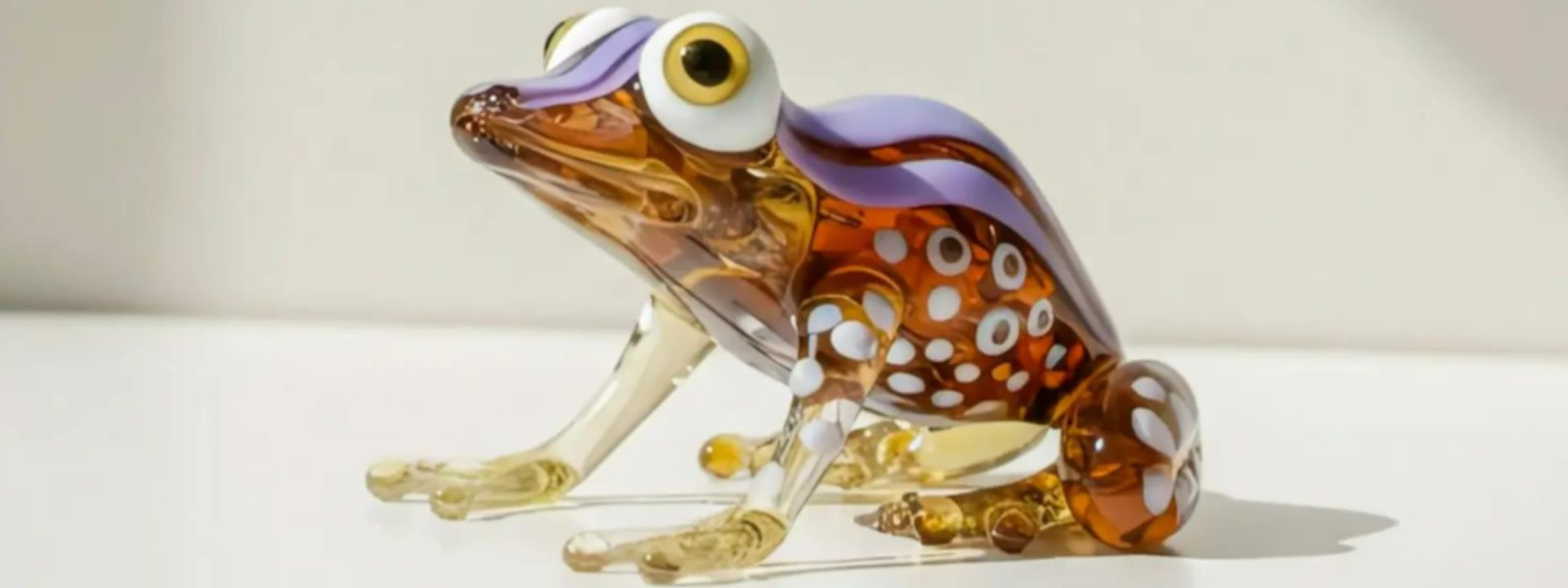
Image by Glass Art Animals
Perfect Statues and Their Broken Shapers
by Adrian Ward
My domain is one of beauty, of brightly colored statues and their dark inhabitants. On the bench before me figures form, carefully cast from molten glass.
At the other workbench Aki lords over a domain of hammers, sends glass-shards spinning with each cracking blow. The glass at his feet whispers murder as he stamps down, iron-booted, and grinds its inhabitants to dust.
Across my workbench, the day’s labor waits: a line of plaster molds, each holding a fortune-frog’s glass-cast facsimile. Statues meant to bring prosperity, the sort that can be found on shop counters or for sale from roadside peddlers.
Curiosities, all. False magic, sold only to the desperate and the gullible.
Ours are no mere baubles.
Yesterday’s batch has cooled. I cut them loose from their plaster and line them up in neat columns.
Thorough examination reveals no flaws, of course. I have made them nearly perfect.
For this batch I added brimstone and powdered seashells, so that the glass is colored a brilliant yellow. Inside each statue twin wisps of light race about, testing the edges of their own miniature domains.
Spirits, imbued into the glass during the cooling process. One to bring prosperity, to give our statues the worth that those sold by peddlers sorely lack.
The other: prosperity’s rival, or perhaps its brother. An evil thing, a parasite. It hungers for release, for the chance to rake its claws through flesh.
Each statue is a masterpiece in miniature. Our buyers will remark on the careful shaping of each toe, each muscle-bound leg, each wide, bulging eye. How much work must have gone into each detail—into ensuring that the statues bring not only prosperity to the shops they will adorn, but beauty as well!
For us, each detail—the stick-out toes, the overextended feet, the overlong legs—serves a more practical purpose.
I pass the statues to Aki. He places one in front of him, watches it closely. Raises his hammer.
Embedded in his arm is a shard of glass, dark and hissing. Its inhabitant despises having similar spirits so near, and it guides his arm as he brings the hammer down.
A wisp enters a foot, and Aki strikes, snapping the foot off with a hammerblow. He sweeps it to the floor, and the evil spirit is crushed beneath his heel.
Again, and again, until each statue is broken. Missing a foot, or toe, or leg, and left with only one inhabiting spirit, which will doubtless bring prosperity.
I have shaped the statues, made them beautiful. It is Aki who makes them perfect.
I found Aki behind the alchemists’ guild, in a rotting heap of food scraps and refuse.
He was young, perhaps ten or twelve. Perhaps younger. He lay perfectly still and watched me through eyes that seemed to have seen all of the horrors in the world.
A failed experiment, I assumed. Cast out like so much garbage.
I had never planned for children. The glass requires most of my time, and my statues are children themselves, needy things that demand constant attention. But I could not leave a child in the garbage heap, to melt into the pile of rotting things until he was no more than a rotting thing himself.
I reached for his arm, to help him up. He flinched, and I withdrew.
“What’s your name?” I asked.
“Aki,” he said, in a voice worn raw from screaming.
“Aki,” I repeated. “Aki. I can’t promise you much, but I can promise you better than this.” I waved a hand, at the garbage heap and the guild, at every damn thing the world had done to him. I wasn’t sure how much he understood. But he rose, hesitantly, and followed me back to my workshop, and I resolved to give him a better life.
At first he ate little and spoke less. When he did speak it was for little things, to ask for water, to ask what I required of him, to apologize despite having done nothing wrong. While I worked the glass he huddled in the corner of the room, as far out of my way as he could get, and kept a careful eye on my statues.
When he had been with me for three months he fell ill. I woke in the night to find him sweating, feverish, barely lucid.
“My arm,” he said, and vomited.
Carefully, I peeled back his sleeve. Beneath it his skin was an inflamed red, swollen, burning to the touch.
Poking out from the skin: the shard, dark and alien against his flesh.
The alchemists had driven it through him, parted flesh and embedded glass into bone. They had made his body a vessel, allowed the evil spirit to flow through him. For what purposes, I have never understood.
There are machinations laid only by the cruel, and the rest of us can only guess at their intentions.
I was angered, and that is far too calm a word for what I felt. But there is little that a mere glass-shaper can do against the alchemists’ guild, so I focused on the boy in front of me, and what I could do to aid him.
I started with statues, fist-sized chunks of glass embedded with spirits of healing. Usually they are simply placed near the injured, or pressed against the skin, and the healing spirits within bring unnaturally swift recovery. I arranged the statues around Aki’s bedroll and hoped they would bring him some relief.
From there I considered my options. I could not summon a medicist, for fear that word of Aki would reach the alchemists’ ears. I certainly couldn’t contact the guild themselves, and ask that they save him from the results of their tinkering.
Instead, I went to my workshop. I heated a healing-statue until it began to soften and deform, becoming malleable and shining in the furnacelight. I took a needle as well, and returned to Aki’s side.
He had turned pale, and beads of sweat stood stark against his face. His eyes were shut, and watery, and his breath came in ragged gasps.
I dipped the end of my needle into soft glass. When I pulled it away, a thin strand trailed behind it.
I punched it into the meat of Aki’s arm and began to pull it through.
Aki screamed and thrashed. I held him down and continued to work, pulling the needle in and out of his flesh, until the pain rendered him unconscious.
I am no surgeon. I could not cut into Aki’s flesh, tear the shard from his bone, and sew him up again. Certainly not without leaving him to bleed, too much to survive.
This was a method I had heard of from other glass-shapers, one that had survived from long-gone times. I could not remove the evil spirit. Sealing it back into its shard, however, binding it tight so that it could do no harm to him. That little, I could do.
When I finished, glass looped out from Aki’s arm, threaded around it, covered the shard. I sat by his side through the night, sponging his forehead with a wet cloth, until his fever broke and color returned to his face.
When he woke he stared bemusedly at the new trails of glass along his arm. He ran a testing finger over them, as if surprised to feel no pain.
“Thank you,” he said, quietly.
He was less silent after that. The sunken hollows of his face filled out. His eyes regained something of life. He sat closer to me while I worked, and I taught him what I could about glass-shaping.
He smiled, finally, when I went to the recordkeep and had him registered as my son.
He never speaks of his parents. Whether that’s for his sake or for mine, I do not know.
If he had grown up in a different era, or a different place, with a different family, he might have had a more typical upbringing. The workshop is no place to raise a child, even if he has well adapted to it.
I am worried, always, that I have failed to raise him well.
On a boiling-hot day in the long midsection of summer, a letter arrives, stamped with the army’s red-wax seal. It requests ten thousand healing-statues, to be made at once, by the king’s decree.
Typically the army’s order is constant: a matter of a hundred statues each month, to be stockpiled. Such an order is easily completed within a week, and pays well enough to keep Aki and myself fed even when other work fails to come.
There had been rumors, spread by merchants, that the king of a neighboring country was dead. That armies were gathering, attracted by the promise of a kingdom in chaos, ripe for the conquering.
The death of a king draws many scavengers to the corpse. I take the letter as confirmation that our armies are among them.
“You could flee,” I tell Aki. I have contacts that could ferry him elsewhere, to some kingdom that will not become embroiled in war. My statues have a reputation for quality, and are easily traded for such favors.
“But you won’t come,” he says. It isn’t a question.
“I cannot,” I tell him. Not in a time of war. I am needed, now, to ensure that fewer of my countrymen wind up dead in the dirt.
“Then I won’t go,” Aki says. “My place is here.”
He turns back to his work. For a moment I consider trying to convince him.
He brings his hammer down, and the shattering of glass drowns out any possibility of argument.
Before I took Aki in, the army’s orders took weeks. Often they demanded all of my time, and I was forced to turn away more interesting requests.
The killing spirits complicated my work.
So long as the glasswork is without flaw, the spirits of good things are content to stay bound. They bring with them benefits. Warmth. Healing. Luck.
The killers, the flesh-rakers, seek any chance to spring from their glass prisons, claws slashing. They follow the good spirits into glass and are terrified to find themselves trapped within it.
They are fragile creatures, while glass-bound. A mere crushing underfoot is sufficient to send them, hissing, into whatever eternity they are destined for. Left within glass, they nullify the good spirit’s effect, and the statue becomes little more than a delicate, dangerous ornament.
Given any chance to escape, they become horrid things, fleshy and wild-eyed and howling, and succumb only to severe wounds.
Before Aki took his place in my workshop, I kept a spearman on retainer. The process was dangerous, then. I would allow a spirit to flit about within my statues, waiting for it to enter one of the protuberances I had shaped. Hammer in hand, I would knock the protuberance off, and destroy it beneath my heel.
If I had chosen correctly, the evil spirit would hiss away underfoot, and the good one would be left in its statue, ready to be sold. Were I wrong, I would be reliant on the spearman to skewer the evil through before its claws could find the soft meat of my throat.
He was successful, but there are still scars across my arms. Some are decades old and have yet to fade.
One day, while Aki watched me work, he asked why I didn’t always kill the evil ones.
Aki was thirteen, then, or perhaps fourteen; we had no way to be sure. He knew that he was born in May, but not how many Mays had passed since he was sold to the guild.
He had been taking more interest in my work, wanting to know the why and the how of things. I answered as best as I could. I thought that he might be interested in glass-shaping himself, but more than that I thought that I owed it to him.
I was his father, or something like it. And is it not the duty of a parent to indulge their child’s curiosity?
“I can’t be sure which is the evil one,” I explained. “They look the same.”
“It’s that one,” he said, and pointed.
His hand trembled. I remembered, then, that dark shard of glass.
I directed the spearman to stand ready, and knocked off the spirit Aki had indicated. It hissed away to nothing beneath my heel.
I waited a moment. Two. The remaining spirit remained within the glass, and did not tear at my guts or drive its claws through my neck.
“Another,” I said, and handed him a second statue.
By the day’s end thirty more evils had hissed away underfoot, and the spearman’s blade remained unbloodied. I kept him another week, as a precaution. When he proved unneeded, I asked Aki to aid me in my work, if he was willing.
“If you’ll allow me to,” he said, and took his place at a workbench.
Since then I have kept a spear at hand, but have yet to use it.
Three weeks after the fighting begins, the army requests my presence at the front.
It would be easier if I were closer. Something about supply lines. Already the kingdom finds itself overstretched, too tired to move.
Our camp is a half-day’s march from the border, at the base of a great hill. A soldier directs us to our temporary workshop, on the hilltop, and we climb up with our packs thumping against our backs.
At the top we pause and look down onto the camp. Just down the hill from us stands an enormous tent, fabric stitch-marked with the interlocking rings of the alchemists’ guild.
Aki sees it, surely, but doesn’t remark on it.
Our country is known not for our martial prowess, but for our craftsmen—the skill of our sculptors and glass-blowers, the genius of our engineers. For the war a full engineering regiment was brought to the front, and in a matter of weeks they had created a full workshop.
Stone-walled, stone-countered. A great furnace set into one wall, fully stocked with coal, and next to it the smaller annealing furnace. In neat rows on rough-cut shelves, all of the trappings of the glass-blower’s profession: jars of lime, lumps of imperfect glass for reshaping, wooden boxes of richly hued colorants. I brought my tools, of course, but a spare set has been furnished, neatly hung from little hooks over the cooling-racks.
“It’s impressive,” Aki says.
“It’s acceptable,” I respond. In truth, it is impressive. Nearly perfect, bar a single error.
“Though there’s only one workbench,” I add.
I cannot blame the army for being unaware of Aki. I have always, if not kept him a secret, avoided making him well known. The alchemists’ guild has many eyes, and a long reach.
“It’s fine,” Aki says. I am sure he means it, would have no qualms about working on the floor. He has never been the sort to complain. The guild had long robbed him of the inclination.
I will not have it. “It is not fine,” I tell him, “and the quartermaster should furnish us with another, if asked.”
Aki says nothing. I exit the workshop, and he follows close behind.
When we find the quartermaster he is deep in conversation with a man who wears the sun-emblazoned robes of the alchemists’ guildlead. I intend to turn around, head back to the workshop, tell Aki that the bench can wait, after all.
The damned quartermaster sees us, and waves us over.
“I seem to be in demand today,” he jokes, gesturing to the guildlead.
“This is Davon,” the quartermaster says. “Davon, these are our glass-shapers.”
The guildlead studies us, slate-gray eyes sweeping over our faces. For a moment I expect that he’ll recognize Aki, and my hand drifts down to the hammer at my belt.
The guildlead extends his hand. Aki stiffens, and I start to reach for him, to remind him not to do anything foolish.
He shrugs me off, and shakes the guildlead’s hand, and looks him in the eye as he does it.
“Well met,” Aki says. I know him well enough, now, to notice when he holds words back.
One morning, when Aki was perhaps fourteen, I woke to find him in the workshop. He had fallen asleep there, leaning against the wall.
As I entered, trying to soften my footsteps, he startled awake. He scrabbled at the floor for a moment, panicked, before reaching into his pocket. He pulled something out, and thrust it at me.
“For you,” he said, and stopped himself from saying anything more.
A bracelet, knotted leather, hung with a great glass bead. Within the bead four spirits circled, chasing each other in endless loops.
It is difficult to impart multiple spirits into the same piece of glass, even for someone of my experience. Doubly so when the piece is small.
I noticed a discoloration on Aki’s fingertip, a slight burn that had not yet healed. I noticed the four tiny chips in the bead, where miniature nodes had been broken off with exacting care.
“Thank you,” I said. Aki pressed the bracelet into my hand, and I slipped it over my wrist.
As he’s grown older, Aki has offered to fashion a new bracelet. He says the original is amateurish, misshapen, easily broken. But I have kept it, and I wear it still.
The days pass in perfect monotony. I produce rows of healing-statues. Aki knocks their evil spirits loose, and turns them to powder underfoot, and so makes the statues perfect.
Outside, somewhere, war. Trickles of news return from the front. The other kingdom, even without their king, refuses to be absorbed. Much of their army survives, thousands of soldiers, and neither side is eager to push forward.
Soldiers stumble back broken and bloody. The unlucky ones do not stumble back at all.
Within the workshop there is none of that. Aki and I sleep and wake and work and joke. We leave only to take food and drink, and to turn over statues by the sackful.
In the third week the alchemists’ guild comes.
They don’t have the decency to come by day, but rather in the long hours of the night, while Aki and I are asleep. The pounding on the door wakes us. I stumble over, rubbing sleep from my eyes, and pull it open.
Guild enforcers, eight of them, crowded around the doorway. Armed with long spears, crosspieced, the sort used for hunting boar.
Behind the enforcers, the guildlead grins.
“Your boy is suspected of dabbling in the black arts,” he says. “We would like to take him in for examination.”
“Did the generals approve this?” I ask.
“That is irrelevant,” the guildlead says. “This matter falls under the guild’s discretion.”
“Damn that,” I say, and step forward.
Immediately a spear rises, pointed at my chest.
“We really would prefer to handle this peacefully,” the guildlead says. “There’s no reward for sheltering him, glass-shaper. He’s a danger. You’re fortunate that I recognized him.”
I think of Aki in the garbage heap, dead-eyed. I think of him in the workshop, crushing spirits underfoot. I know which I prefer.
He is my child, not the guild’s plaything. I stand there, considering my options, ready to claw and tear and bite. I cannot win, but perhaps I can give Aki the chance to flee, to escape. I step forward, and a second spear rises.
“Don’t,” Aki says. He is behind me in the doorway, needs to run, to hide, but instead he steps out into the night, into the circle of spears.
“Don’t,” I say, as if in imitation, and reach for his shoulder. He brushes off my arm without looking back.
“A good decision,” the guildlead says, and motions for his enforcers to stand down. They part before Aki as he walks forward, closing behind him with brutal finality.
“Take care of yourself, Dad,” Aki says. He might sound strong if I did not know him, if I couldn’t make out the tremble in his voice.
The first time Aki calls me Dad, he is being taken away by the guild, spear-herded off into the night.
When I was young, I watched the kingsguard take a man. He had been accused of working against the crown, and they dragged him out from his shop while he thrashed and wailed and proclaimed his innocence.
They took him away, and he never returned. We heard, months later, that the king had declared him guilty. He’d been locked away in some prison or another, or else put to death, no one was quite sure. Eventually his name faded from everyone’s lips and minds and worries, and life continued on.
I remember that man, as I watch the dark shapes of the enforcers lead Aki down to the alchemists’ tent. The way he screamed.
But the guild, despite their efforts, are not the kingsguard, and I will not allow them to have my son.
I gather what weapons I can. Into my belt, my hammer. My plaster-knife. A ladle.
Finally I pull my bracelet onto my wrist, and let the workshop door close behind me.
A lone guard stands watch in front of the guild’s tent. He doesn’t leave the entrance, and barely bothers to glance around.
The guild has always been arrogant.
There are no tents behind the guild’s, as if the earth is dead and empty in their wake. It suits my purposes well as I pull stakes from the ground.
The bottom of the tent loosens. I flatten myself to the ground and crawl under.
Inside, the tent is bright, buzzing with the light of some contraption or another. For a moment I am blinded, and stay flat against the ground, waiting for my vision to return.
When I am sighted again, I pull myself forward, under the canvas flap, and crouch behind a set of crates. Atop them, lines of statues. Warped things, hideous, filled with swirling wisps.
I am not Aki, but even I can tell that the statues have been imparted with nothing good. The air around them is thick, heavy with malice.
Beyond them, across the tent, the alchemists are gathered. In their center, Aki, strapped to a table.
An alchemist leans down. A moment later Aki yells, pained, and that is enough to set me into motion.
I am no soldier. Little chance, then, of taking on the alchemists on my own, facing two dozen and somehow coming out on top.
Instead I raise my hammer, and send statues shattering to the floor.
Spirits gush out, malicious things, growing limbs and teeth and tearing claws. The alchemists turn at the sound and are met by a tide of evils—frenzied, ravenous—and soon begin to scream.
I rush over to Aki. He stares up at me, wide-eyed, as I begin sawing at his restraints.
“You came,” he says.
“Of course,” I say, snapping his last binding. No time, now, for other words. I pull Aki to his feet and we run for the tent-door.
All around us, the snap of bone, the shattering of glass, screams and yells and whimpers. The hot spray of saliva thrown from gnashing teeth. Part of me feels a brutal satisfaction, and I wonder whether Aki feels it as well.
A tugging at my sleeve. On the ground, reaching for me, the guildlead, bloody-faced. I bring my hammer down, and his nose smashes apart like so much glass.
Close to the exit, now. Twenty feet. Ten. Claws tear at my back. I expect to fall, to feel great gashes carved into my flesh, but the pain doesn’t come. Instead, the bracelet on my wrist cracks apart, and behind us the spirits are a wall of light that throws the evils back.
“You used warding spirits,” I say, incredulous, and I think I hear Aki laugh.
We break out into the night, bloody, panting. The watchman yells, draws his sword on us.
I am buzzing with adrenaline, and the watchman seems weightless as I shove him into the tent. A moment later he begins to scream.
As I begin to pull forward, Aki stops.
“We need to leave,” I say.
“I know,” he says, “but we can’t let the spirits run free.” He waves a hand at the camp, at the dark figures beginning to stir from soldiers’ tents, at all of the people who have nothing to do with evil spirits or alchemists except for proximity. The shard in his arm hums, angry or perhaps excited, as he reaches for the watchman’s fallen sword.
Aki has always been kind—no, not kind. Unselfish.
He pushes back into the tent, and I do not stop him. The screams and hisses redouble.
A minute. Two. Then silence.
When Aki emerges from the tent he is bloody. Behind him, before the tent-flap shuts, a glimpse at the dead. The spirits, torn, in stinking heaps on the floor. Strewn among them, the bodies of alchemists. Once or twice, something in-between, an alchemist with the twisted, clawed arms of an evil spirit or a spirit with a man’s face, puffed purple in the firelight.
If Aki was a failure, I suppose they were the successes.
All cut, by sword or by claw. I can’t tell which. I don’t ask.
Aki follows silently as I turn away, and we leave the corpses behind.
We stop in the workshop just long enough for me to sweep tools into a sack. On second consideration, I add a handful of healing-statues. Useful, possibly, though Aki seems mostly unhurt. At the least they should fetch a good price.
We head off into the night. Behind us, the clamor of soldiers as they surround the alchemists’ tent, shouts as they discover the bodies.
They’ll send pursuers, eventually. Even if the deaths of the alchemists are put down to a failed experiment, my absence will be noticed. I am needed, in a time of war, and difficult to replace.
But it should be some time before they think to search for us, and by then we can be well elsewhere. There should be work for us, in other kingdoms. We can carve out a new life.
I glance over to Aki, and find him shaking. Young, still, and caught up in all of this.
I am ashamed to have done so little tonight, but this I can do: I reach over and pull him close.
He stiffens at first, then begins to shake, and then wipes the tears from his eyes.
“We’ll rest, at some point,” I tell him. “I want to be far from here before sunrise.”
I mean we’ll find something better and I’m sorry I couldn’t be a better father and I hope you can forgive me. I don’t know if any of that comes through.
But Aki nods as if he understands, and we press on.
Host Commentary
War is always brutal, and costly, particularly for children. Childhood can be cut short in so many awful ways – loss of home and family, injury and death, conscription, and the diseases that follow in their wake. Aki’s mistreatment in the background of this story begins at a very early age, and while not directly as a consequence of war at that stage, the callous indifference of the alchemist’s guild and commodification of human flesh very much set the tone for future events in that society. The story’s protagonist gives shelter to Aki, and a chance to heal, but it’s a long, slow process for them both. What comes of it is a beautiful depiction of adoptive family ties.
For our 700th episode, I very much wanted to showcase one of our Young Author submissions. Along with our Banned Books Week event, I consider publishing stories written by teenagers, and by new writers of older ages, to be one of the cornerstones of what we do. We’re currently in the final stages of reviewing this year’s Young Author submissions, but you can expect a few more stories from prior rounds very soon, including another fantastic story from this author for you to look forward to.
About the Author
Adrian Ward
Adrian Ward is a student and writer originally from North Carolina, whose fiction has appeared in publications including Beneath Ceaseless Skies, Small Wonders, and Apex. He can be found online at adrianwardwrites.wordpress.com and on Bluesky @adrianwardwrites.
About the Narrator
Alasdair Stuart
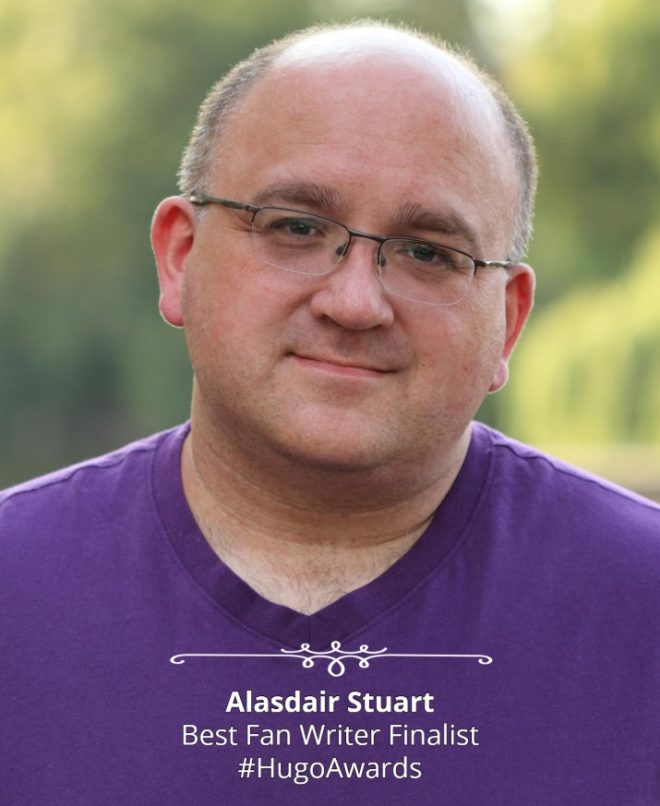
Alasdair Stuart is a professional enthusiast, pop culture analyst, writer and voice actor. He co-owns the Escape Artists podcasts and hosts their weekly horror fiction show, PseudoPod. He is an Audioverse Award winner, a multiple Hugo Award and BFA finalist, writes the multiple-award nominated weekly pop culture newsletter, The Full Lid, blogs at alasdairstuart.com, streams on Twitch, and can be found on social media @AlasdairStuart.
