

Cast of Wonders 684: Little Wonders 49 – Aging Memories
The Girl Detective
by Nadia Radovich
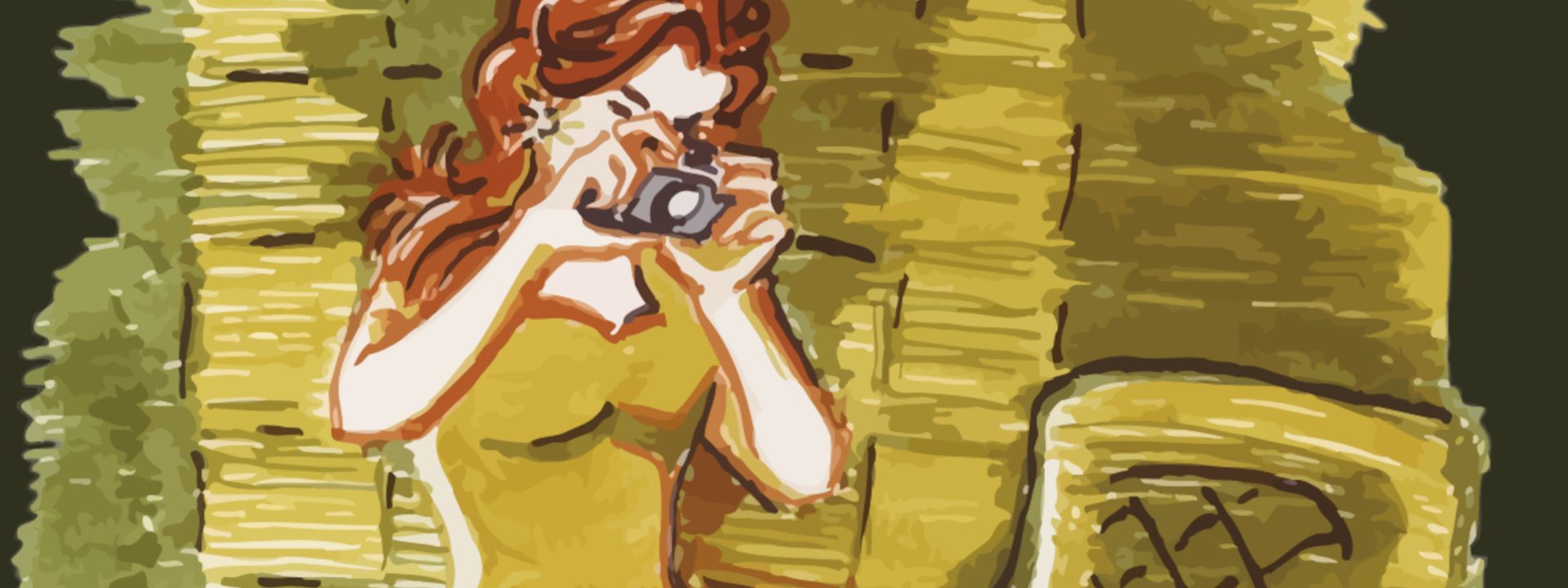
You: twelve, uncertain, under-dressed. The Girl Detective: fox-haired, quick-witted, fictional. Always zooming about, passport in one hand, magnifying glass in the other. Congenitally incapable of au-pairing in Madrid, skiing in the Alps, taking a train anywhere, without stumbling into some tantalizing mystery.
Your friend, Zofia: solving puzzles so fast that the Girl Detective never dies, not even in the game’s final level. You sit at her elbow, watching her deft mouse movements search chests, accuse suspects, dodge falling tiles. In the sunlight at recess you see the faint hint of fox color in her hair.
Then, in seventh grade, your friend Zofia: dead. You: at the funeral, the dim church light stealing all the copper from her hair, wondering if you only remembered it that way.
Zofia’s mom always liked you. Before she moves closer to family, she gives you Zofia’s games. Zofia’s fingerprints are still on the jewel case of the one she was saving to play with you.
You boot it up on your mom’s work computer, a quiet misbehavior earned by grief. You stall, start again, stare at puzzles Zofia could have solved. The Girl Detective is in Lima. She’s drinking yerba mate alongside the Pacific Ocean, interrogating the secretive guests in her hotel.
Perhaps you dream it—you never find the cutscene again, never see it mentioned on online forums—but, exasperated by the hotel guests lying about their motives, the Girl Detective turns to you.
And you, Kathryn? she asks, hair shining in the lemon-yellow sunlight. What do you want?
You think about Zofia’s still face, the color greyed away.
“I want to remember her,” you say. “Every single detail.”
The Girl Detective: eyes like coins, smile like a wisp of smoke.
A small wish, but I can grant it, she says. You will.
You: twenty, in your women’s voices in popular media seminar. You realize that the Girl Detective fulfilled your wish—you just phrased it wrong. You didn’t say who you meant. You have to flip back through your scrapbook to remember Zofia’s eye color, but you remember the path through the castle’s hedge maze perfectly: left, right, left, left, right. You remember the key to the clock’s internal mechanism is in the secret drawer. You remember the precise way the sunlight slanted against the wallpaper in the Girl Detective’s bedroom.
It’s stupid that you’re forgetting Zofia but can remember this. In class, you try to write her down instead of notes, but it never works. There’s always a divide between your words and your memories, which you can narrow but never cross. Not for anything except the Girl Detective.
You: thirty, all-but-dissertation, still wishing you can purge your memory of these stupid games, but mostly so you can use the freed-up space for your reading list instead. Talking to your adviser, you waffle between indignantly explaining why these puzzle-heavy learning games for girls matter, and wondering if maybe your adviser is right, and you should save your passion for real art.
It feels like cutting off a part of yourself, like accelerating the destruction of your memories. But you manage it. You still write about women’s voices, but only the ones that people already agree are important. It makes you important. It pays your salary. You can afford to get married, have kids.
You: forty. You finally acknowledge that, after years of waiting, the next Girl Detective game is not coming. Your daughter is her namesake Zofia’s age, her last one. Then you blink: the moment passes, and your memory rushes in, coloring over it, filling in the gaps. Like the water outside that seaside hotel in Lima, constantly smoothing out all the lines in the sand.
You: in your fifties, an empty-nester. You can’t remember Zofia’s last name or where her mom was from. Your mom would know. But she’s gone now, too. Slipped with Zofia past the final door, the one you haven’t found the key to yet.
You haven’t played the games since your children were young enough to play them with you. But when you can’t sleep— when you’re worrying that your children will get in trouble, or not make friends, or fail their classes, or become academics— you lie awake and play them in your mind. Three clicks forward into the kitchen, where the chef doesn’t know you know he did it yet. Each stroke familiar, each line unchanged.
You: sixty-something, and sick in a way you can negotiate with but never recover from. Your last trip to the store. Your last walk through the neighborhood. Your last time getting out of bed. Your family by your side.
“Can we get you anything, Mama?” your daughter asks. You can’t remember her name. Sickness has wiped that from your mind, too. Everything except for this last thing.
The three words take two tries. A frantic scamper of movement in your room. Your daughter, her voice thick: “My fucking tablet doesn’t support a stupid fucking CD drive—“
You want to tell her it’s okay. That you may have forgotten everything else, but thanks to a wish made by mistake long ago, you remember this, perfectly.
You load the last game in your mind.
You: twelve again, sitting outside your hotel in Lima. Yerba mate steaming on the table before you, which you bought with in-game soles, the Peruvian currency.
Across from you: your fox-haired friend, twelve and bright and smiling again. Her magnifying glass rests on the table, concentrating the world into a single point of light.
You think she will ask you something— do you remember her? Was your life happy? Did you ever regret your wish?
But the two of you just sit there together, sipping yerba mate, listening to the canned loop of street sounds. Knowing that your guests are in the hotel, but they’ll wait for you a little longer, until you decide to go inside.
Silver Screen Syndrome
by Mia Xuan
These days, my father only responds when we point a camera at him, and that’s if the lighting’s right. When he’s gilded by a glorious summer afternoon in the park, he’s Dad again, shooting at the goal from forty yards out and whooping when the ball whips in. The recording shakes as we pump our arms in celebration, turning him into a blue-gray blur in his bargain-rack sweatpants and quarter-zip. But the afternoons never last, so neither does he, and we all watch as his face goes slack when the light dims.
At home, it’s harder. The desk lamps and ceiling fixtures in our house never seem cinematic enough, but we make do. The moonlight passing through the bedroom window can pass for chiaroscuro, if we angle the blinds just so. He’s got a face for film noir, stern and gaunt, even if we wish he suited a different genre. So we set the scene: a desk lamp illuminating a stack of children’s storybooks on our nightstands, one of us lying down with our limbs askew, the blankets rumpling up from our restlessness. Someone else leads Dad into the room before retreating out of the frame, cell phone camera aimed at the bed. The focus latches onto his fingers absently tapping away on the books, then the faint smudge of a smile. He asks us about our day, but his voice always goes too soft, too solemn, and it’s like his shadow on the wall is talking instead. In the shot, it looms behind him like a vulture, because none of us can do subtlety. Inevitably, our breath catches for too long when we try to answer him, and he starts apologizing for the empty spaces he’ll leave behind. You can almost hear the cue for the sad piano, and Mom can’t bear it.
So we don’t record too much at night. Our camera rolls are filled with breathless blue skies and rose gold clouds, great green fields to run rampant in, forests brilliant with all of autumn’s regalia. Days so fresh that they demand you enjoy it, urgently, because you know every second is closer to too late.
It used to be that a plain camcorder could get him going, the kind with washed-out lighting and an LED timestamp in the corner. Back then, the three of us kids would cluster around our beige pleather couch, brimming with whatever scripts we could sift from school and sports and the everyday sediment of suburbia. We smacked and wrestled each other into the glass sliding doors and recliners so he would muss our hair and call us names he reserved for bad drivers and surly cats. On the table, we laid out sparkling cider in champagne flutes next to apples chopped into bunny slices, just the way he used to serve it, while we sprawled in a mass of pillows and snacks and cards, our rambunctiousness as precisely articulated as a blueprint.
With Mom perching like a sniper on stairways or armrests, camera in hand, we sought out compositions that gave him a space to slot into, a role to play, with the persistence of hunting dogs. If we placed the sheet music on the piano just so, then kept our hands poised over the keys, sometimes he would stop by to whistle out the tune. Or if we minced the parsley gingerly enough, furrowing our brows in concentration, he’d scoff and show us how it was done.
When the light slants over the dining room table at a good angle, we start scattering notes and textbooks and pens in an artful scramble, the picture of the intrepid scholar. It didn’t matter if Dad came by to tease or applaud or quiz or encourage or one-up us. Whoever’s at the books smiles so hard at him, hugs him so tight, like it’ll keep him anchored for just one more moment. Whoever’s at the camera stands still, so still, holding onto the shot as long as they can.
But they always cut away, eventually.
Mom is usually behind the camera, so she doesn’t have nearly as many recordings with Dad as we do. In most of them, she’s crying as he tries to comfort her, which often leads to more crying. We tried to surprise her once. A dinner date for her and Dad, the dining room decked out with velvet curtains and candles, the table set with Grandma’s best silverware and the expensive cuts from the only fancy restaurant in town. After some finagling, we shoved Dad into nice slacks and a suit, while Mom dug out an evening dress from the depths of her closet after coming home from work.
They reminisced over their childhoods from a hundred years ago, laughing about old dates and misadventures, like the time my aunt pushed them into a shed to hide them from Mom’s parents. They shared an old vintage merlot Dad had finally remembered, that he’d been keeping for a special occasion. They serenaded each other with old radio ballads while we feigned vomiting from the kitchen island. Everything went perfectly.
It was nothing like how they usually hung out before, Mom half-watching a procedural, Dad botching a crossword upstairs as he munched on chips. He’d call for a hint and she’d holler back the answers, and then he looked up spoilers for her show in revenge. Whenever they did the laundry or the dishes, they’d tag in and out for each other, as smooth and banal as a traffic light at an intersection. Nothing you’d ever notice.
“I’m sorry I wasn’t happier,” she said to us as she helped us wash up, rubbing at her eyes with soapy hands. “It’s silly, isn’t it? To miss how someone used to sulk about taking out the garbage.”
Dad starts fizzling out faster and faster, and entire nights become minutes-long clips become a montage of us beaming at each other in different rooms of the house. Mom parcels out his grasp on us as long as she can, but soon he only gives us a snapshot’s worth of a smile before sliding away. So she upgrades the camera to a movie-grade machine gun of a model that can shoot every flick of our eyes in close-up, every wisp of hair caught in the breeze. She upgrades the footage from the everyday to the momentous occasion, and we lug that thing around wedding venues and campus gates, taking turns hauling it out of the trunk with the tripod knocking against our knees, so Dad can come alive and we can catch the tears welling up in his eyes when the bouquets or graduation caps go flying.
But then we need more angles, because cameras are worse than sieves, there’s always something slipping through, a moment that doesn’t come out right: a joke that Dad doesn’t respond to because the gales of laughter aren’t hearty enough, a running tackle that doesn’t have enough force to register. Soon all of us are mounting tripods and setting timers and coaching each other on our expressions to make sure we’re beatific enough. Mom brings around a speaker, in case we need a suitable score: soaring symphonies, perhaps, or a sweet lilting melody, to get us all in the right mood. She asks us to retake the more subdued reunions, so afraid that we’ll refuse that we can’t help but obey, delivering our introductions with more gusto. We give our aunts and uncles a script for returning our greetings and push our toddling cousins out of the way so they won’t spoil the scene by gabbling about bodily functions.
When we watch the celebrations back, stitched together in a parade of jubilant faces, we can imagine that we had a good time.
I can’t tell Mom this, but sometimes I go into the memory cards and camera rolls and clear out old recordings so that they can bleed away like watercolor pigment. Even if they’re important. Especially if they’re important. Everything is, these days. It’s a luxury, having moments that don’t matter, moments you don’t have to treasure, as inexhaustible as a river. The clip of him ribbing me about taking his car on a joyride and giving me permission “as long as it’s in the middle of the night and nobody’s looking,” the time he taught me how to make borscht and I managed to burn it—everything with my father is rationed, fraught. I don’t want to borrow his car when I know he doesn’t need it for his commute anymore. I don’t want to make his favorite stew because he can’t do it these days.
I don’t want to watch me grieve him, so I keep my phone shut off at night. When I see him hovering in the doorway, a blank shadow against the moonlit wall, I guide him back to his room and sit next to him in total darkness, feeling out the empty space he’s going to leave behind, without anyone to see.
About the Authors
Mia Xuan
Mia Xuan is a writer and thesaurus enthusiast from New Jersey, USA. She enjoys drawing, making comics, and coming up with bad puns. Her work has previously been featured in Apparition Lit, Speculative City, Archive of the Odd, and The Skull and Laurel.
Nadia Radovich
Nadia Radovich is a writer from North Carolina, now based in D.C. Her short fiction has appeared in Apex Magazine, Apparition Literary Magazine, Strange Horizons, and others. She is on Bluesky @NadiaRadovich.bsky.social.
About the Narrators
Rish Outfield

Rish Outfield is a writer, podcaster, security guard, and voice actor. He is afraid of ghosts, spiders, mummies, branches on windows, those coin-operated rocking animals they used to have outside grocery stores, the sound of the wind, little girls in white dresses, big girls in black dresses, porcelain dolls, hitchhikers, the Boogeyman, the Amish, department store mannequins, and paintings of children in Victorian garb. Wait, did you not ask what sorts of fears Rish has? Major embarrassment. Also something Rish is afraid of.
Karen Menzel (née Bovenmyer)

Karen Menzel (née Bovenmyer) earned an MFA in Creative Writing: Popular Fiction from the University of Southern Maine. She teaches and mentors students at Iowa State University and Western Technical College. She is the 2016 recipient of the Horror Writers Association Mary Wollstonecraft Shelley Scholarship. Her poems, short stories and novellas appear in more than 40 publications and her first novel, SWIFT FOR THE SUN, debuted from Dreamspinner Press in 2017. Karen’s website is at https://karenbovenmyer.com/. Karen was an assistant editor of PseudoPod team from 2018 to 2021.
